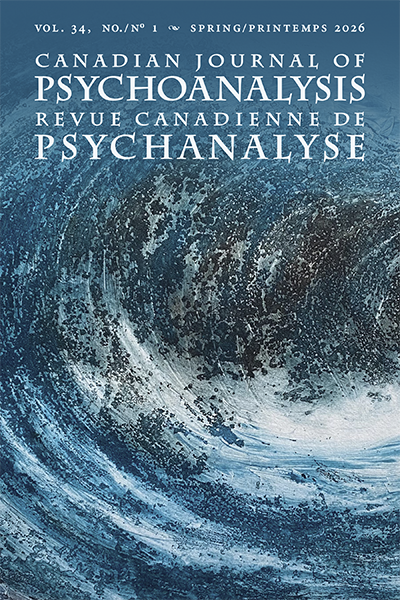

Vol. 34, No. 1, Spring 2026
Contents
INTRODUCTION
Louis Brunet, Margaret Ann Fitzpatrick Hanly, Marie Claire Lanctôt Bélanger, Darren Thompson
In waves, and with some regularity, psychoanalysis is denigrated by psychologists and psychiatrists who proudly proclaim themselves the worthy possessors of scientifically validated psychotherapies…
Read the rest (Download the introduction in PDF)
ARTICLES
Face à la déliaison mortifère du narcissisme et de la haine, investir la pluralité
Georges Gaillard
Contemporary changes are transforming people’s psyches and the ways in which they “are together.” They affect the register of identification and the ways in which people invest (in themselves and others), correlating with the temptation of a narcissist who has been freed from the burden of otherness. How, as analysts, do we become sensitive to the upheavals underway and to the way in which subjects are reshaping their (libidinal and social) supports? How do we invest in the plurality of our own (individual and group) subjective functioning and contribute to the restoration of intermediate processes; how do we work to ensure that hatred and narcissism diminish in conflictuality and participate in Kulturarbeit?
Keywords: narcissism, hatred, mutation, identification, investment, plurality, Kulturarbeit
L’art de créer dans les addictions : approche psychopathologique psychanalytique de la figuration du corps
Isabelle Boulze-Launay  , Simon Dureuil , Jean-Philippe Roustant , Corinne Gal , and Alain Rigaud
This article explores the role of body representation associated with sensations and verbalization in addiction. We examine the relationship to sensations based on the prototype of birth trauma as a point of pathogenic regression. For this purpose, we study two painters known for their addictions: Francis Bacon and Edvard Munch. Their creativity allows us to see and hear sensations in their paintings through two very different processes. Bacon and Munch free themselves from the anguish of trauma by putting gaze and voice under tension in an original figuration that leads each painter to an act of birth through art. These unique creations invite us to think of clinical practice under transference as a staging of sensations in the therapeutic space, allowing the addict subject to “see” and “be seen” and to “speak” and “be heard” in a different way.
Keywords: corps, figuration, sensation, créativité, parole, addictions
Les effets cliniques de la langue d’origine et étrangère dans la cure psychanalytique
Gabriel Mart
This article analyzes how natural language contributes to the structuring of psychological conflict in contemporary analytical practice. Through examination of three clinical vignettes informed by Charles Brenner’s modern conflict theory and Jeffrey Jackson’s conception of language as a compromise formation, it demonstrates that mother tongues and foreign languages cannot be reduced to mere vectors of communication: they constitute genuine active matrices that organize defensive modalities, compromise formations, and transferential configurations. The analysis suggests that what matters most in clinical practice is not the abstract “mother tongue versus foreign language” opposition but each individual’s unique history with their respective languages and the unconscious charge they attribute to them. Consequently, the linguistic configuration of treatment becomes a genuine technical tool for analytical work on resistance and transference, particularly in current contexts of increased international mobility.
Keywords: multilingualism in psychoanalysis, compromise formation, modern conflict theory, transference, psychic defenses, analysis in a foreign language
La psychothérapie basée sur la transitionnalité. Première partie : une théorie du fonctionnement psychique
Wilfrid Reid
To introduce the concept of transitionality, the author offers a comparative study of the metapsychologies of Freud and Winnicott. The first topology focuses on the contents of the psychic apparatus, which has by then reached “its present perfection.” Winnicott, on the other hand, focuses on the psychic apparatus itself. In the second topology, Freud presents an original state of the psyche, which has become a project, a declaration of intent, and not an instrument of transformation: the Ego must differentiate itself from the Id. Winnicott’s maturational process will become this instrument of transformation. In the après-coup of Green’s thought, the successful outcome of the maturation process will allow for the emergence of a third topology, whose instances will be the self and the object. This third topology, arising from the establishment of the generative dimension of the Ego, will form a system by actualizing a transitional psychic space and temporality that will allow the transition from a second-topology model of psychic functioning to a first-topology model of psychic functioning through the hidden existence of transitionality.
Keywords: hallucinatory, maturation process, third topology, transitionality
« Vivre sa vie » : la mère morte et les vicissitudes du transfert amoureux
Johanna Velt
In this article, the author examines the various facets of a patient’s pronounced love transference, exploring its Oedipal, pre-Oedipal, “basic” or narcissistic nature, as well as its positive or negative valence and its entanglements and disentanglements. While the analysis begins under positive auspices, the analyst is quickly confronted with the dead mother, which André Green (1982/2007) describes as a true revelation of transference. A pivotal moment enables the author to interpret the maternal transference as both loving and hostile, and she subsequently discusses its initial effects.
Keywords: transference, basic transference, dead mother, narcissism, resistance
REVIEWS
Appréhender le présent à la lumière du passé
Le présent de la psychanalyse, nº 14 (septembre 2025)
Reviewed by Marie Claire Lanctôt Bélanger
Here I’m Alive: The Spirit of Music in Psychoanalysis by Adam Blum, Peter Goldberg, and Michael Levin
Reviewed by Gordon Yanchyshyn
Download the Table of Contents (PDF)
Previous Issues
Vol. 33, No. 2, Fall 2025
(Download table of contents PDF)
Vol. 33, No. 1, Spring 2025
(Download table of contents PDF)
Vol. 32, No. 2, Fall 2024
(Download table of contents PDF)
Vol. 32, No. 1, Spring 2024
(Download table of contents PDF)
Vol. 31, No. 2, Fall 2023
(Download table of contents PDF)
Vol. 31, No. 1, Spring 2023
(Download table of contents PDF)
Vol. 30, No. 2, Fall 2022
(Download table of contents PDF)
Vol. 30, No. 1, Spring 2022
(Download table of contents PDF)
Vol. 29, No. 2, Fall 2021
(Download table of contents PDF)
Vol. 29, No. 1, Spring 2021
(Download table of contents PDF)